The Sky Queen of Mount St. Helens
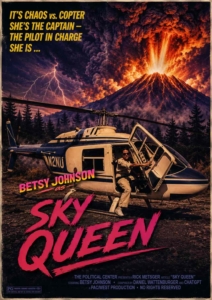
Mother’s Day, 1980. A time for arrays of flowers and a mimosa bash. Instead, it turned into a time for showers of molten ash. An eruption disruption.
Forty-six years ago today, Mount St. Helens blew her top. Those old enough to remember recall the vivid images on their TV screen.
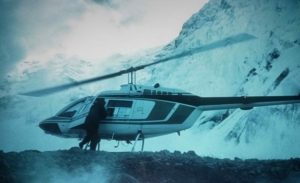
Betsy Johnson has different recollections, ones that not only are seared in her mind but also seared her eyebrows. Her window to nature’s fury was directly in front of the windshield of her Bell JetRanger helicopter, dodging ash plumes and wind phenomena so sudden and erratic it could flip her whirlybird like a pancake.
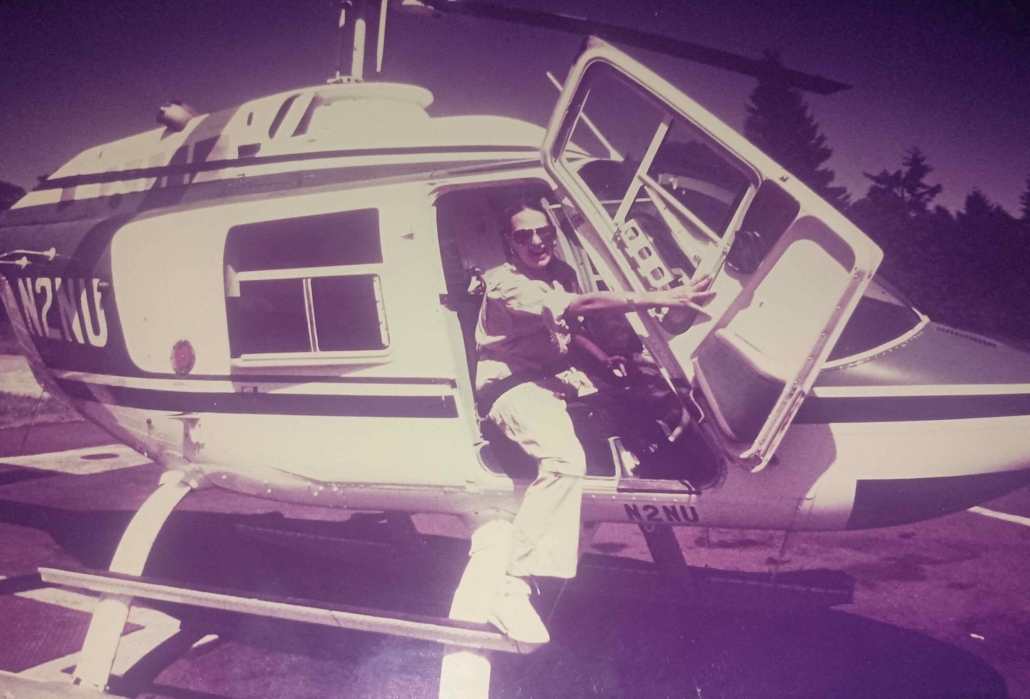
Yes, that Betsy Johnson. She was the Captain, the Pilot in Charge. She was Betsy Johnson — Sky Queen.
Betsy Johnson and her Bell JetRanger helicopter.
Before she owned the title State Senator or gubernatorial candidate as one of Oregon’s leading political power players, Johnson was the ace flyer for just about every TV news crew in Portland as they competed to capture the story of the decade.
“I was very agnostic,” Johnson explains. “I would fly them all, Channel 2,6,8, didn’t matter. We didn’t care about their Nielsen rating, only their credit rating”
Have copter, will travel. It was the days of the television helicopter wars. Every station it seemed broadcast more commercials touting their helicopters than their advertisers’ wares. There was KATU’s Chopper 1, News Chopper 6, SKY8, and Air12. They were usually rented — often the same helicopter — and frequently with Betsy behind the stick.
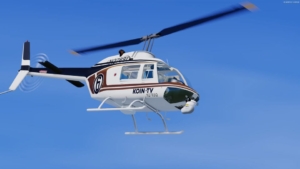
“I remember one time during the eruption days, I was standing down waiting for the crew from Channel 6,” Johnson said. “A reporter from KGW came up and said he had a videotape he had to get rushed to the station ASAP. We had a little time, so I said sure. But he said there was no way in hell he could ride a helicopter with Channel 6 on the side of it and land it on the KGW pad. So, the took some gaffer tape and changed the 6 into an 8 and off we went.”
Johnson’s Mt. St. Helens duties started months earlier when flying for the U.S. Geological Survey.
“We had started by planting all the seismic monitors around the mountain,” she said. “I remember we used a parking lot near the mountain which is now pulverized and resting in Montana somewhere.
As the days and weeks went on the mountain got more and more active. Everyone wanted to fly up there. If we had 1,000 helicopters we probably could have booked them all.
“Traffic ‘control’ I think was being handled by folks in some Midwestern state. It was crazy. We had news crews from France and Japan that hired us to take them up to the mountain. There were so many people from all around the world and they couldn’t get hotel rooms nearby. We had an aviation reporter from TIME Magazine sleeping in our hangar.
“So many people were flying around I am surprised we didn’t play bumpy aircraft. The biggest concern I had was with my news crews onboard. They were so competitive and wanted to get the story better than anyone else. I had to remind them about command and control.”
Everyone was on edge as the bulge in the side of the mountain continued to grow. Seismologists at the University of Washington were carefully looking for any signs of an impending eruption. Any blip on the screen could be the triggering moment.
After 46 years, Johnson said it was time to confess her unwitting role in anxiety creation.
“One day we took a break, landing at the top of the crater. I stood there kicking some pretty large stones and watching them crash down into the cauldron. I found out later every stone I launched triggered a jump on the seismic monitor being watched by a nervous seismologist. It was really just a very bored pilot,” she laughed.
She also had a number of interactions with the irascible Harry R. Truman, the owner and caretaker of Mt. St. Helens Lodge at Spirit Lake (no relation to the former U.S. president) who refused to leave his home despite constant pleas. Just days before the eruption the word spread that Harry had changed his mind and wanted to evacuate. KOIN, with News Chopper 6 and pilot Johnson went to the rescue.
Except Harry wasn’t budging.
“Who the (expletive) told you I wanted to leave? I’m not going anywhere,” Harry said.
“The last thing I saw of Harry as we were lifting off,” Johnson said, “was him sitting on his porch holding up a drink. I could hear the ice cubes clinking in my mind. He is now buried under an estimated 150 feet of volcanic ash.”
Betsy marveled at the huge swath of trees destroyed by the volcano.
“From a distance it just looked like a normal stand of trees, but as I flew closer you could see they were all mowed down flat like a box of matchsticks. Then as we flew over the Toutle River it was filled with logs just banging into the bridge abutments in the river,” she said.
Johnson said the experience also taught her a lot about the incompatibility of aircraft and ash. “We explored new ways to destroy rotor blades and engines,” she said. “There was so much ash in the air it actually started eating holes in our rotor blades.”
Some of the crews even became creative chefs. “One guy took some chicken and a pig and roasted them right there under the pyroclastic flow,” she said.
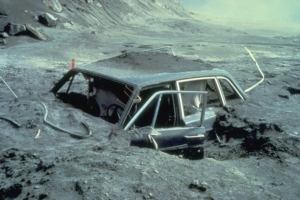
The most poignant moment, Betsy said, came years after the eruption. There was a photographer, Reid Blackburn from The Columbian newspaper, on the mountain taking pictures when it erupted. He was miles away but the flow moved so fast he couldn’t escape. He climbed in his car but the heat killed him instantly.
Years later, a camera was found in the debris.
“The camera was sent to a special lab in California where they did forensic work and confirmed it was one of Reid’s cameras. I went to his parents’ home and presented them their son’s camera. His mother began quoting scripture about the return of the lost lamb. It was an incredibly emotional moment that I will never forget,” she said.
Betsy left one volcano and journeyed to another, joining the Oregon Legislature in 2001 and later the Oregon Senate where she was a seismic force as Co-Chair of the Joint Ways & Means Committee. In 2022 she ran as an unaffiliated candidate for Governor, a race won by Democrat Tina Kotek.
For her, the comparison of life experiences is easy.
“I’d rather spend 10 years circling an active volcano than six months on the campaign trail,” she laughed.
Keep your altitude high and your stress low. Such is the moto of Oregon’s “Sky Queen.”