
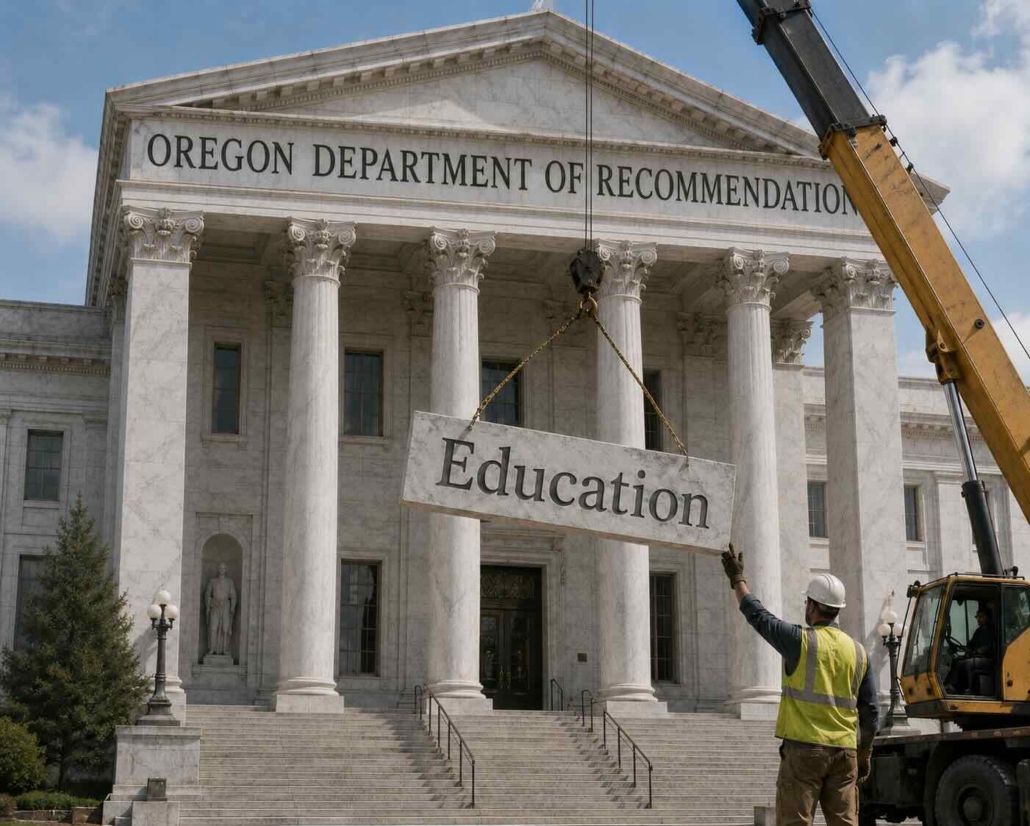
Oregon’s Department of Recommendations
Why Oregon’s education accountability system still lacks real teeth
Don’t know much about algebra. Don’t know what a slide rule is for.
But I do know one and one is two!
— “What a Wonderful World,” Herman’s Hermits
Sometimes the bar gets set so low that just stepping over it is hailed as a success.
When it comes to public education in Oregon — where fourth- and eighth-grade reading and math skills slosh the bottom of the 50 state barrel — the battle cry, “Let’s make the Top 40” appears to be our North Star. “What a Wonderful World” that is not.
Oregon’s Department of Education (ODE) was designed at statehood to lead Oregon’s students into adulthood with the educational skills necessary to succeed. But its toolbelt has neither a hammer nor a screwdriver. Instead, it leans heavily on masking tape, Gorilla Glue, and notes of encouragement.
EDENTULOUS: “Toothless; Having no teeth”
— Merriam-Webster
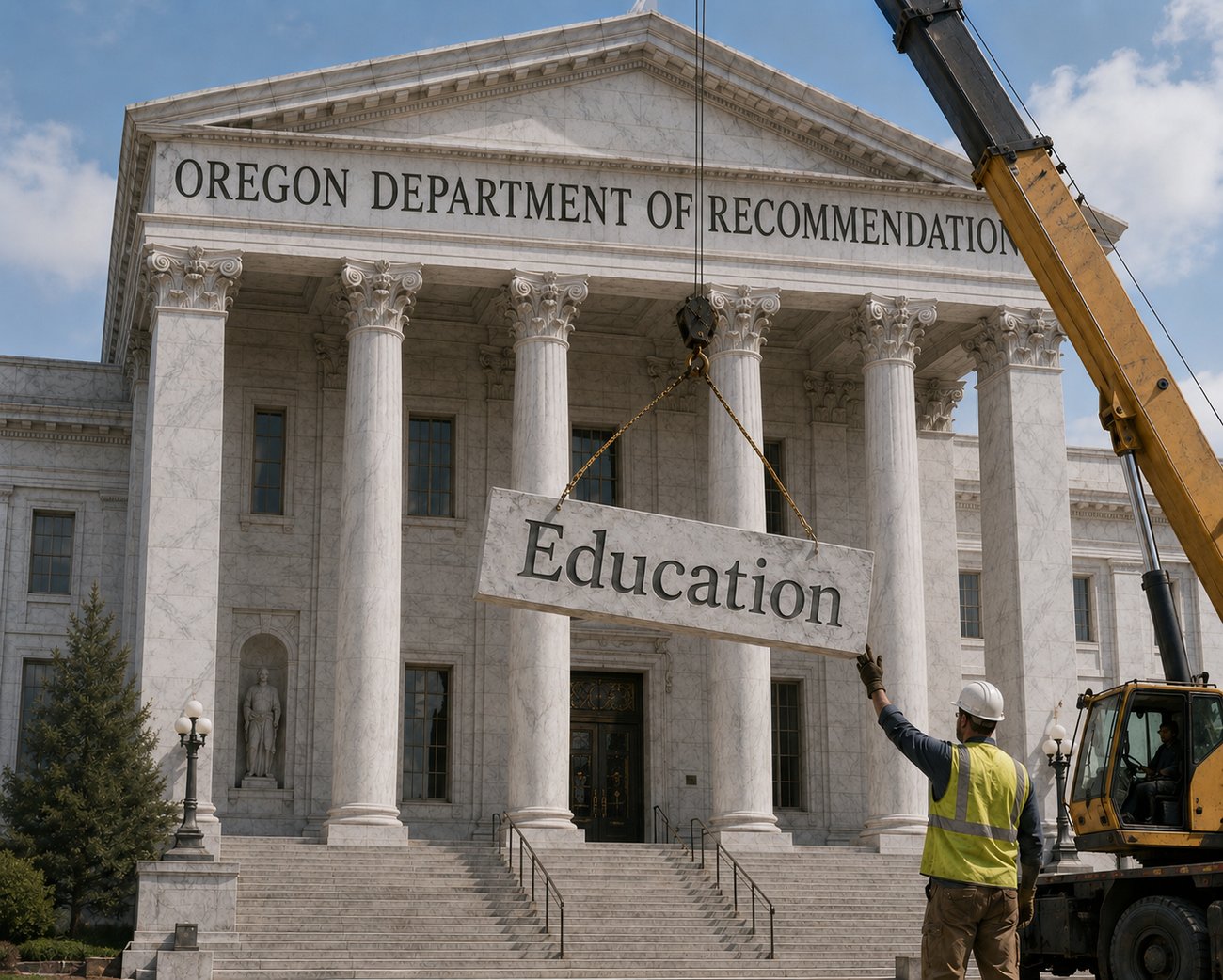
Despite some recent advancements, the Department of Education still operates more like the Department of Recommendations. They develop guides for school districts, offer advice and coaching, prepare charts, graphs, and issue glossy reports. If students fail to achieve, they are offered counseling.
Compliance for academic achievement comes under what is referred to as the Division 22 Standards. But it starts with a small “c.” Withholding of state funds never materializes.
The Student Success Act of 2019 provided additional money to schools for targeted expenditures and built in a level of accountability for those funds. But former Sen. Mark Hass, an architect of the Act, says more is needed.
“We need to address the entire school accountability architecture,” Hass said. “We dropped the Student Success Act into a system that has none of that.”
To her credit, Gov. Tina Kotek attempted to strengthen accountability in the 2023 session but was confronted with what Hass refers to as “the powerful forces of the status quo.”
Enforcing accountability, outcomes, and results requires a steel-lined wetsuit when diving into a pool of political piranha, all swimming together to defend an antique structure.
Kotek did help engineer the passage of SB 141 in 2025 to strengthen accountability and transparency, and won the support of the education establishment. But a school district can still be deficient for almost half a decade before the money stick comes into play.
Even then, it only allows the DOE to direct where a portion of state funds can be spent by the district. It doesn’t authorize withholding those funds, but accountability will flow where the money doth go.
To be clear: the systemic problems don’t emanate from the professionals in the classroom. Those teachers doing their best to produce results in a structurally deficient system.
A few short years have added to the challenges. Smartphones and social media are learning inhibiters on attention and absorption. Kotek took an important step in demanding students need to be separated from Facebook and TikTok when in the classroom.
Classroom disrupters can’t be grabbed by their shirt collars and tossed in the principal’s office anymore. We once called that discipline; now it’s called assault. Teachers have all the responsibilities and few defenses.
Much, however, can be changed. Classroom days remain among the shortest in the nation. Absenteeism in Oregon is second-highest in the nation. And testing? What testing? In many districts, less than half of early readers even take the “required” exam to measure their progress. How do you know where you are going if you don’t know where you are? How is this possible?
Thanks to intensive lobbying by the teachers union, Oregon passed a law in 2015 allowing students to opt out of the federally required standardized test for math and English. No test, no evidence of failure or need for improvement. Now Oregon ranks at the bottom in the U.S. on both critical subjects based on scores from those who did take the test.
Former Gov. John Kitzhaber says, “The opt-out must be changed.” Hass, the former senator agrees. “When accountability is optional, outcomes are too,” he said.
You must pass a test in Oregon to be a hairdresser, to drive a car, and even to pour a beer. But pass a test to move into the next grade level or get a diploma? Apparently that’s outrageous.
Oregon can change that by eliminating the opt-out provision and all the smoke and mirrors that was used to pass it in the first place. Putting teeth into the DOE to prohibit grade advancement until the test is taken would quickly change behavior and lift Oregon off the barrel floor and elevate it with other states, at least in something. Instead, we have allowed schools to bury the evidence and shuffle away the responsibility to identify and serve the students most in need.
Hass shakes his head when reciting his own child’s experience at Beaverton’s Mountainside High School. “My kid’s assessments are now referred to by the school as ‘opportunities’ rather than exams, tests, or midterms,” he said.
What if we engaged our schools with the same fervor we engage businesses that aren’t meeting state requirements?
Consider the teeth and bite of other state agencies. Next door to the education building is the Division of Financial Regulation (DFR). After just 12 months of not meeting its Medicare Advantage requirements, DFR regulators this month stepped in and took over the finances of a health insurer, directing all spending and prohibiting the insurer’s management from accessing any of the money. Do our kids deserve the same sense of urgency?
Our educational failure is not the only example of failed government, but it is symptomatic of a broader problem.
“Oregon’s future depends to a large extent on taking on these structures and institutions, and if necessary, the constituencies that are keeping them in place,” Kitzhaber said. “Doing so requires political courage and leadership — leadership (that is) willing to lead these constituencies, not just cater to them.”
Until the DOE is given real teeth by the legislature and supported by executive leadership, we will continue to gum our way along.
Don’t know much about history. Don’t know much biology. But I do know enough about the French I took that “laissez-faire” isn’t going to cut it. “Le sentiment d’urgence” must be the response.

