
Off the Bench and Into the Game
How Edith Green startled a skinny-dipping senator and inspired the birth of Title IX
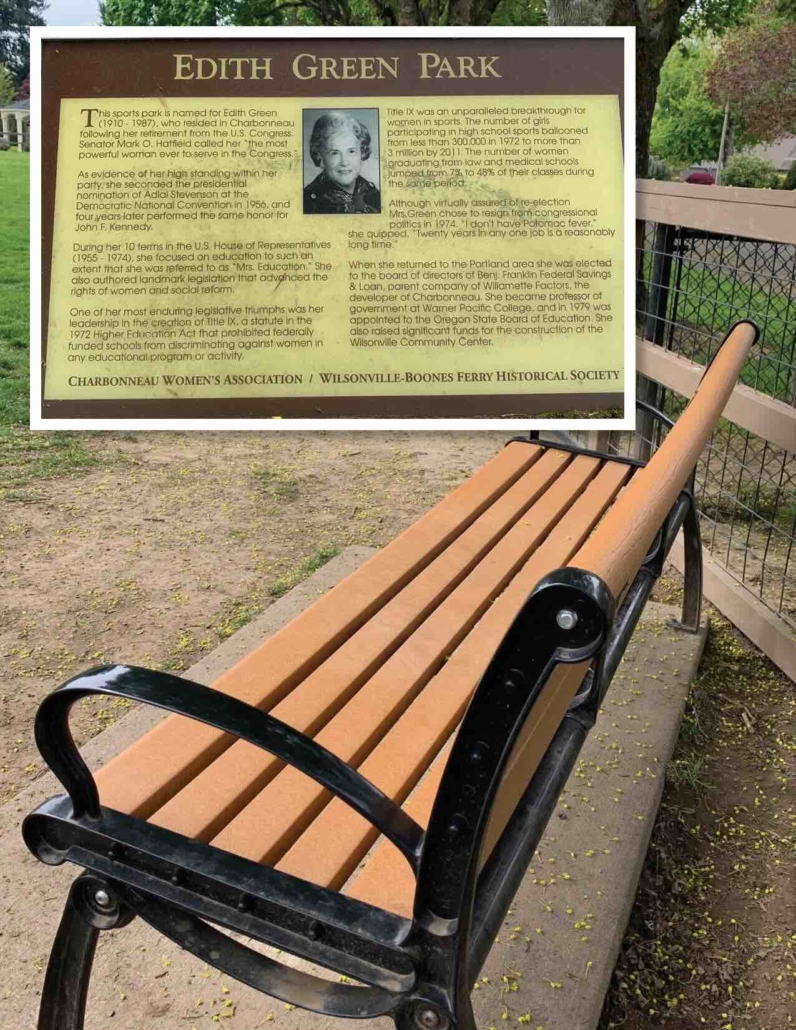
Nestled within the neighborhood community of Charbonneau is a small park, a plaque, and a bench. It is quiet this spring morning, just a slight breeze nudging at the ears of a curious bystander, ready to reveal a story.
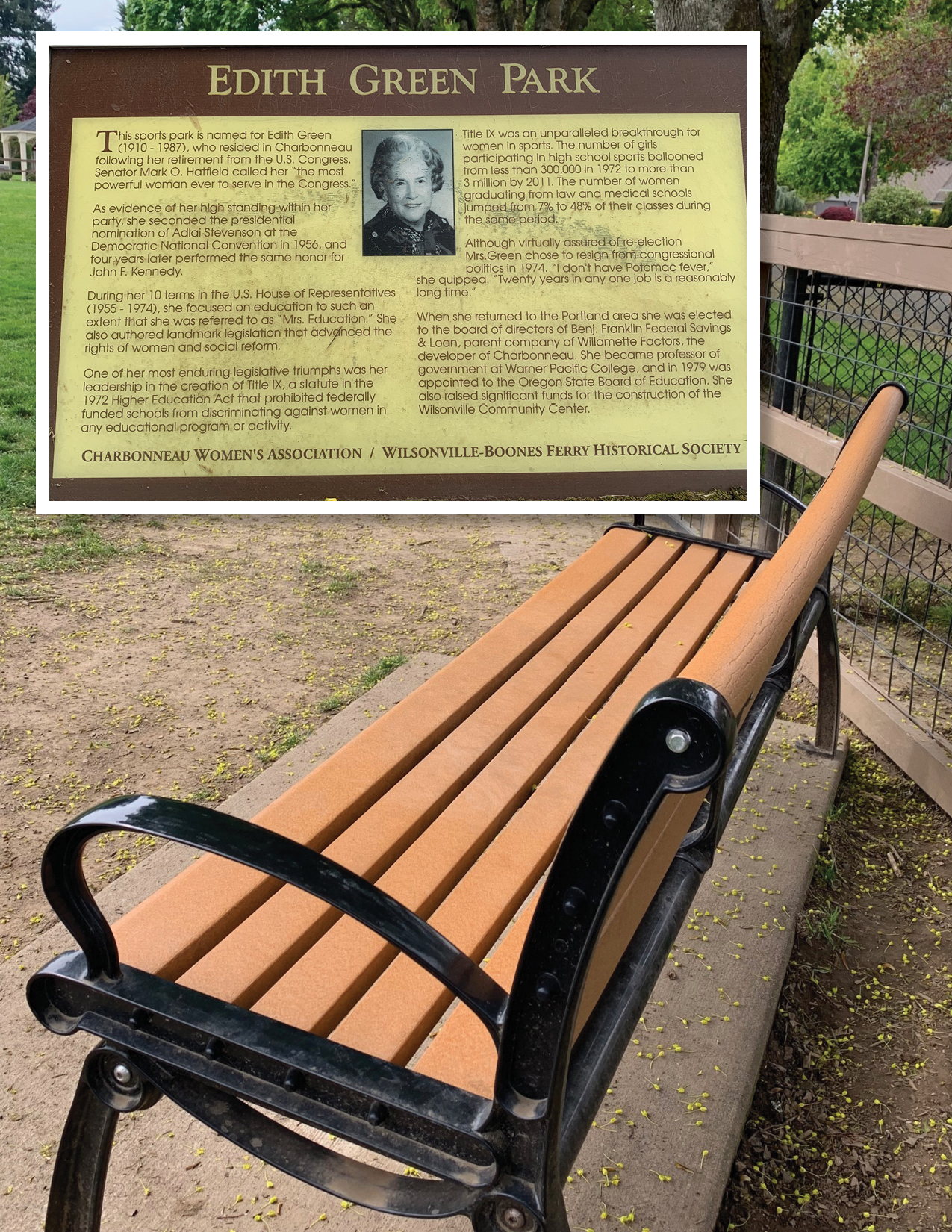
This week marks 39 years since Edith Green’s passing. Few younger Oregonians likely have heard of her, but many owe their careers at least in part to the grit and determination of a woman who served Oregon for 20 years in the United States Congress.
Green, a former teacher, debate coach, and education lobbyist, entered Congress in 1953 having defeated future Oregon political icon Tom McCall. She served 10 terms in a House of Representatives dominated by men and their view of the hierarchy of political order. Men belonged in the House and women in the home.
Her focus was on higher education, and virtually every major piece of legislation in that arena during her tenure had her fingerprints indelibly embedded on it — the Library Services Act of 1956, National Defense Education Act of 1958, Equal Pay Act of 1963, and Higher Ed Act of 1965. She became known around the Capitol as “Mrs. Education.”
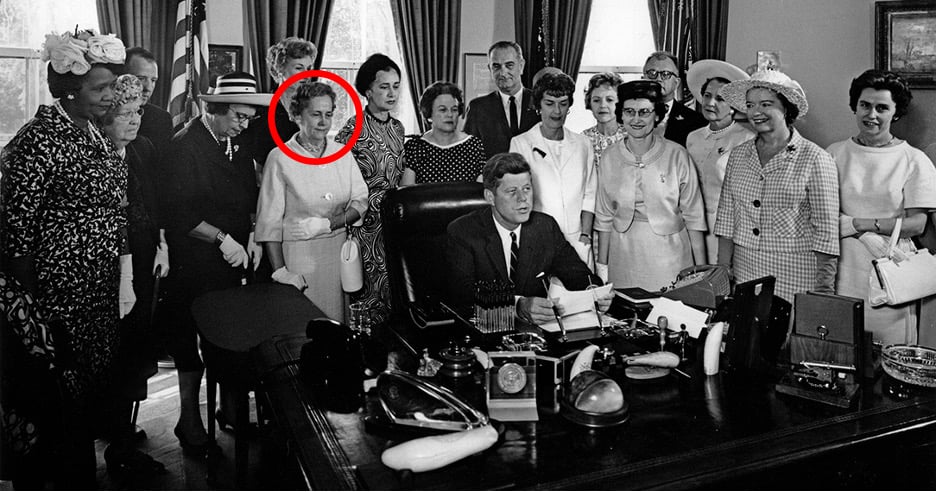
U.S. Rep. Edith Green attends the signing of the Equal Pay Act by President John F. Kennedy in 1963.
So respected was Green, John F. Kennedy called upon her to second his nomination for President at the Democratic Convention in 1960.
But perhaps her greatest achievement began in the early 1960s with a walk to the “Members Only” Congressional swimming pool. By “Members,” it meant male members only. Women, of which there were very few in Congress at the time, were not included in the definition.
When she approached the door, she was informed by the attending staff that her presence would not be appropriate because “many of the congressmen liked to swim in the nude.”
Green was unfazed and undeterred. Not so the lone senator that was backstroking in his birthday suit. You might say it was a Kodak moment.
Congress had just spent $500,000 on upgraded facilities for the benefit of the male members. The women? They were given a much smaller space, “hardly bigger than a closet” as one female member described it, complete with “a few vibrator belts and a half dozen hair dryers.”
The moment may have inspired Green to tackle her next and most lasting achievement — gender inequality in the nation’s colleges and universities for both academic and athletic opportunity. She wasn’t just ready to swim in the same pool; she could do laps around most of her colleagues when it came to advancing controversial legislation.
In a New York Times obituary in 1987, Congresswoman Green’s son James noted: “She realized she had to work with the men before she knocked them over.” And work she did.
Rep. Patsy Mink of Hawaii took on the role of chief sponsor and Green, as the Chair of the Subcommittee on Higher Education, held more than seven days of hearings on the gender equality bill. Green had found an ally, Sen. Birch Bayh of Indiana in the Senate, who promised to spearhead the legislation there if she could push it through the House.
She held up her end of the bargain and Bayh his. Title IX was born and signed into law on June 23, 1972, by President Richard Nixon.
The late Oregon Senator Mark Hatfield once said of his colleague: “She was the most powerful woman to ever serve in the Congress.”
Title IX, while known primarily for implementing gender equality in college athletics, reached far wider. It provided women equality in admissions, scholarships, and fellowships. Achievement begins with access, and Title IX kicked away the doorstop.
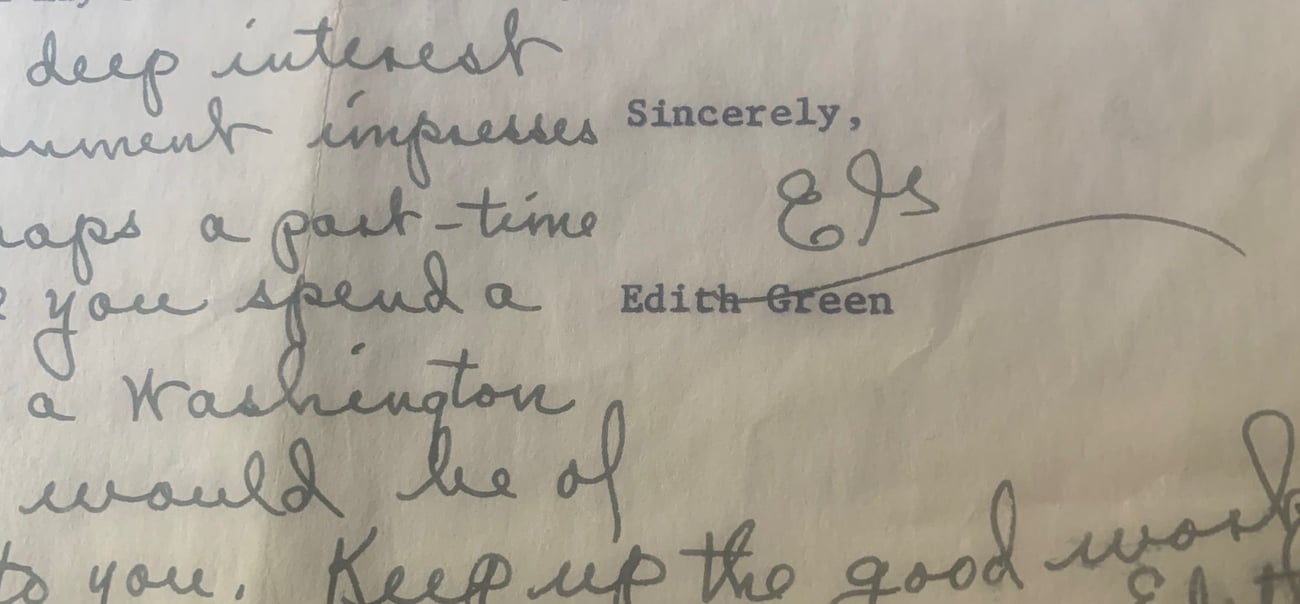
In the late 1960s while prepping for the high school debate championships, I had a surprise encounter with the Congresswoman, followed by a letter and handwritten note the following week in my mailbox. She asked if I enrolled in a D.C. based college, would I consider a part time job in her congressional office. I have often looked back at that letter, still nesting in a shoebox, and wondered what it would have been like working alongside the Congresswoman who was then crafting what became the landmark higher education legislation of the 20th century.
Two years after the passage of her signature legislation, Green suddenly announced she would not seek re-election and would retire from Congress. Unlike many of her colleagues, she felt comfortable that Congress would be able to survive without her. She quipped: “They won’t have to drag me out of here in a coffin — I don’t have Potomac Fever.”
Green returned to Oregon, reconnected to her teaching roots, becoming a professor of government affairs at Warner Pacific College while also serving on the State Board of Higher Education. She passed away from cancer at her home in Charbonneau on April 21, 1987.
It is difficult to look at that park bench in Charbonneau and not smile at the irony. The bench is the last place you would ever find her. Edith Green was always on the field and at the top of her game.

