
What A Thousand Oregon Businesses Just Told Us
When Gov. Tina Kotek launched her statewide Prosperity Initiative late last year, there was a fair question hanging in the air:
Is this going to be real? Or is this going to be another exercise in checking boxes?
The Prosperity Council, as part of this initiative, offered some early signs that it might be different. Kotek brought in longtime political rival, former Senate Republican Leader Tim Knopp, to lead the effort. It was a noteworthy choice to tap an adversary who led the longest walkout in state history in protest of her past agenda. If nothing else, it was a signal that this might be more than a performative exercise.
But structure only matters if the substance follows.
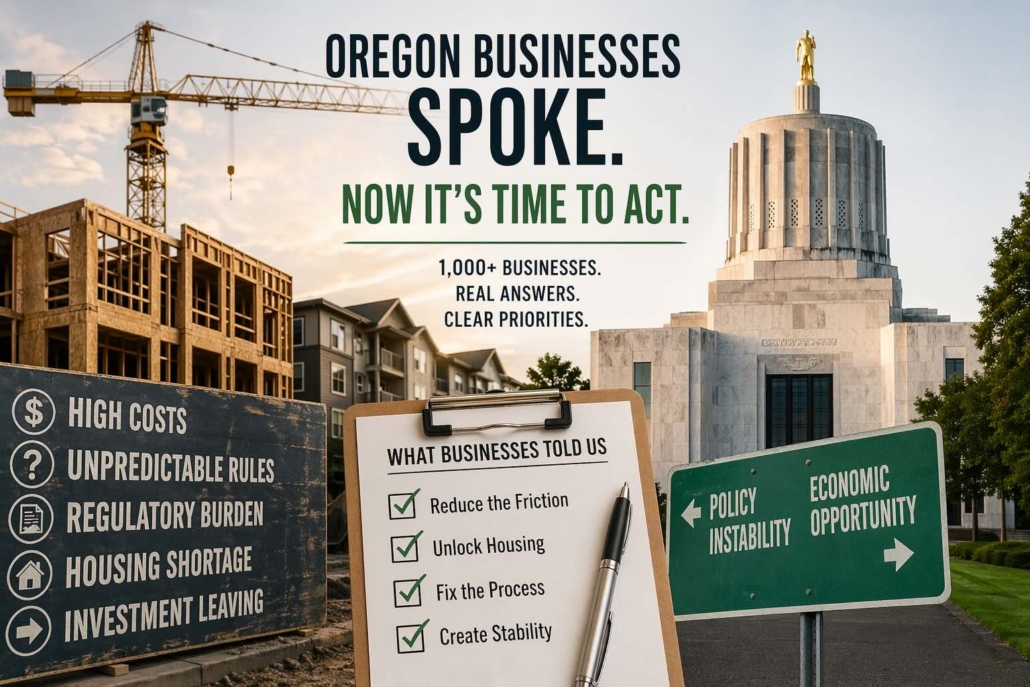
Now for the first time, we have something real to interpret. More than 1,000 businesses across Oregon recently responded in their own words to open-ended questions about what’s holding them back, and what needs to change.
No multiple choice. No curated answers. Just raw input. And the signals are consistent.
The Prosperity Council has been delivered not a list of grievances, but a set of instructions.

1. Reduce the Friction
Across industries — including construction, real estate, manufacturing, and small businesses — the same theme shows up repeatedly, that the cost of doing business in Oregon is both high and layered. Taxes, fees, compliance requirements, reporting standards, and permitting conditions stack on top of one another.
The issue isn’t any one policy. It’s the weight of policy accumulation. What businesses have described is a system where the weight keeps increasing without a clear understanding of the impact of that load.
2. Unlock Housing
One issue that ties this entire dataset together is insufficient housing development. It is identified as central constraint on economic growth.
Employers can’t hire if workers can’t find housing. Workers can’t stay if they can’t afford to live here.
The barriers of limited buildable land, permitting delays, and regulatory uncertainty are well known. But what is new is how clearly and consistently it’s coming through from the business community itself.
Housing deficiency places constraints on everything else.
3. Fix the Process
Another pattern that emerges is that even if businesses can live with a policy, they struggle with the process.
Timelines stretch unpredictably. Rules shift depending on jurisdiction. Agencies don’t coordinate seamlessly.
How rules are applied, how long they take, and whether anyone can reliably plan around them breeds uncertainty in the cost that fosters delayed projects, increased financing risk, and, in many cases, decisions not to move forward at all.
4. Create Stability
At the heart of their message, businesses expressed they can adapt to policy but not constant change.
Take rent control. It was established in 2019, expanded in 2023, expanded again in 2025, and the chair of the House Housing Committee is already hinting at further changes in 2027. That pattern sends a clear message to the people expected to build and operate housing that the rules here are not stable. Instability stifles investment.
And here’s what business owners notice immediately — that when it comes to publicly financed housing, the state fully understands the realities of debt service, operating costs, and the need for revenue to sustain the asset.
But when those same realities show up in the private sector, they’re often treated as optional or even suspect.
That double standard matters because capital notices, and increasingly that capital is choosing to go somewhere else.
What This Actually Requires
What business leaders are asking for is restraint. Restraint from the Legislature constantly rewriting the rules. Restraint from agencies layering on new requirements without removing old ones. Restraint at every level of government to let policy settle long enough to proactively evaluate what actually works.
Local governments play a role. They can’t fix everything happening at the state level, but they can control critical areas. They can align processes across jurisdictions, so projects don’t face different standards depending on where they land. They can standardize expectations and timelines and reduce unnecessary friction in permitting and review.
The strategic reality is that when local governments are aligned, it becomes easier to demand alignment from the state and harder for misaligned policy to stick.
The Test
The Prosperity Council now has clear, direct feedback from the drivers of Oregon’s economic engine. They asked and they received.
The only question that really matters now is, will the state be willing to respond structurally to what it just heard? Or will it be a return to the status quo, hoping for a different result?

