
The Day the Daylight Died
Senate Democrats took a bold step opening their caucus to the press. Then they became the majority party
On Feb. 2, the Oregon Senate convened the 2026 legislative session with its first order of business being the adoption of Senate rules. At first glance they look properly structured and orderly. But take a closer look and you will see something odd about page 2. There is a gap between Senate rule 2.20 and Senate rule 2.50. That gap has not been filled in almost 20 years.
With the passing of former state Sen. Avel Gordly, this is a good time to tell the story of the principled senator who stood in that gap.
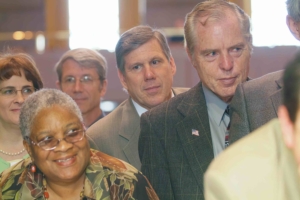
State Sen. Avel Gordly participates in a caucus meeting in 2007. (Photo contributed by Lynn Howlett)
I was elected to the Senate in 1998 as a Democrat representing the district now held by Republican Sen. Christine Drazan. First order of business was finding a place to live while in Salem. Growing up in the 1960s of Rolling Stones, flower children and Woodstock, the idea of communal living seemed aligned with the universe. So along with my 60s colleagues — Sens. Ginny Burdick, Frank Shields, and Gordly — we became housemates in a historic home, five blocks from the Capitol on Court Street.
We were the minority party. Republicans held a quorum-proof majority of 20-10 during the previous session, but with my election along with those of Lee Beyer and Peter Courtney, the margin was trimmed to four.
Being in the minority in both chambers provides little opportunity to gain attention to your legislative priorities. Coming from a journalism background, I thought opening our caucus meetings to the press would be a way to not only show our commitment to transparency in government deliberations but also afford us a way to get our messages out more effectively through the mass media.
When first broaching the idea, it was like I had just spoken blasphemy. “These are family discussions,” was the phrase most often retorted. I needed help to “expand the family” to get a majority of the caucus to agree.
That came from my housemates. Sen. Burdick, a former reporter for Associated Press, was willing to carry the flag and Sen. Gordly embraced the idea enthusiastically.
Gordly was the perfect example that influence is not measured in decibels. She told caucus members it was our chance, even in the minority, to show our values and what we stand for; that this was the people’s business and we were their spokespeople. With the help of Gordly’s impassioned plea, we became the first legislative caucus in Oregon history to open deliberations to the press.
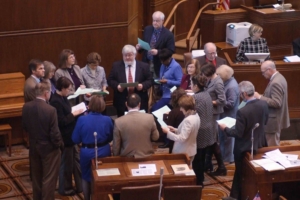
The caucus meets in the Oregon Senate in 2007. (Photo contributed by Lynn Howlett)
Senate Rule 2.30 was later adopted by the full Senate:
RULES OF THE SENATE 2005
2.30 Policy for Open Caucus Meetings
It is the policy of the Senate that the public have as much information as possible regarding matters relating to the conduct of Senate business. Consistent with that policy, caucus leaders are strongly encouraged to allow the presence of accredited representatives of the news media in caucus meetings, except during discussions of personnel matters, organizational meetings to elect officers of the caucus and the Senate, and other matters not involving deliberation of the business of the Senate.
We could not force the Republicans to open their caucus as well, but it set an expectation on what transparent government should be.
Sen. Kate Brown, our caucus leader, was not enamored with the idea, but she did a commendable job implementing it and keeping true to the spirit. The press jumped at the opportunity, and for the first time, members felt our messages were gaining public exposure. We also learned it was a valuable platform for detailing what we saw as flaws in legislation being pushed across the aisle, and the actors involved.
Not everyone was happy of course. Sen. Tony Corcoran hated it, but when reminded years later that it never seemed to inhibit him from speaking his mind he laughed in acknowledgement.
Members adapted to the presence of the media over time and in many cases learned how to use that to their advantage.
Things changed midway through the 2005 Session. Senate Democrats were now in the majority while the House was still under firm Republican control. Tensions were mounting, voices were raising, deliberations and partisan bickering becoming more intense. Some members in the caucus were growing uneasy that the press might reveal various strategies to the opposing party through their stories.
A decision was made to hold one meeting secretly out of the Capitol (as if anything is secret around there) to avoid the press. The press blasted the move in the ensuing days. As the session was moving to final negotiations more meetings were taken “off campus.” Gordly would have nothing of it and refused to attend the secret meetings that were in violation of the caucus’s own rules. Her strong convictions and personal principles were a line she would not cross.
By session’s end, Sen. Gordly was dismayed by the increased partisanship and bitterness it was brewing. Closing the caucus to public view was the breaking point so she made a politically bold break herself as then-Oregonian reporter Jeff Mapes chronicled in an interview with Gordly 15 years ago.
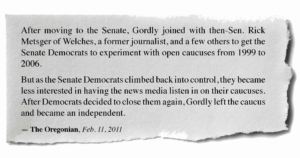
When the gavel struck to open the 2007 legislative session, Sen. Gordly was the only unaffiliated member in the chamber. Her values had not changed. To her, she was bearing testament to those values. The first order of business was to adopt Rules for the 2007 session. They were essentially the same as the session before except a gap appeared on page two. Senate Rule 2.30 was gone.
That gap remains today and serves as a reminder that the only government body in Oregon exempted from public meetings laws by the Legislature is the Legislature itself and the gap in transparency that can create. Sen. Gordly did her best to stand in that gap.
