
Access or Excess?
Legislators Mull a Bill for All Sessions
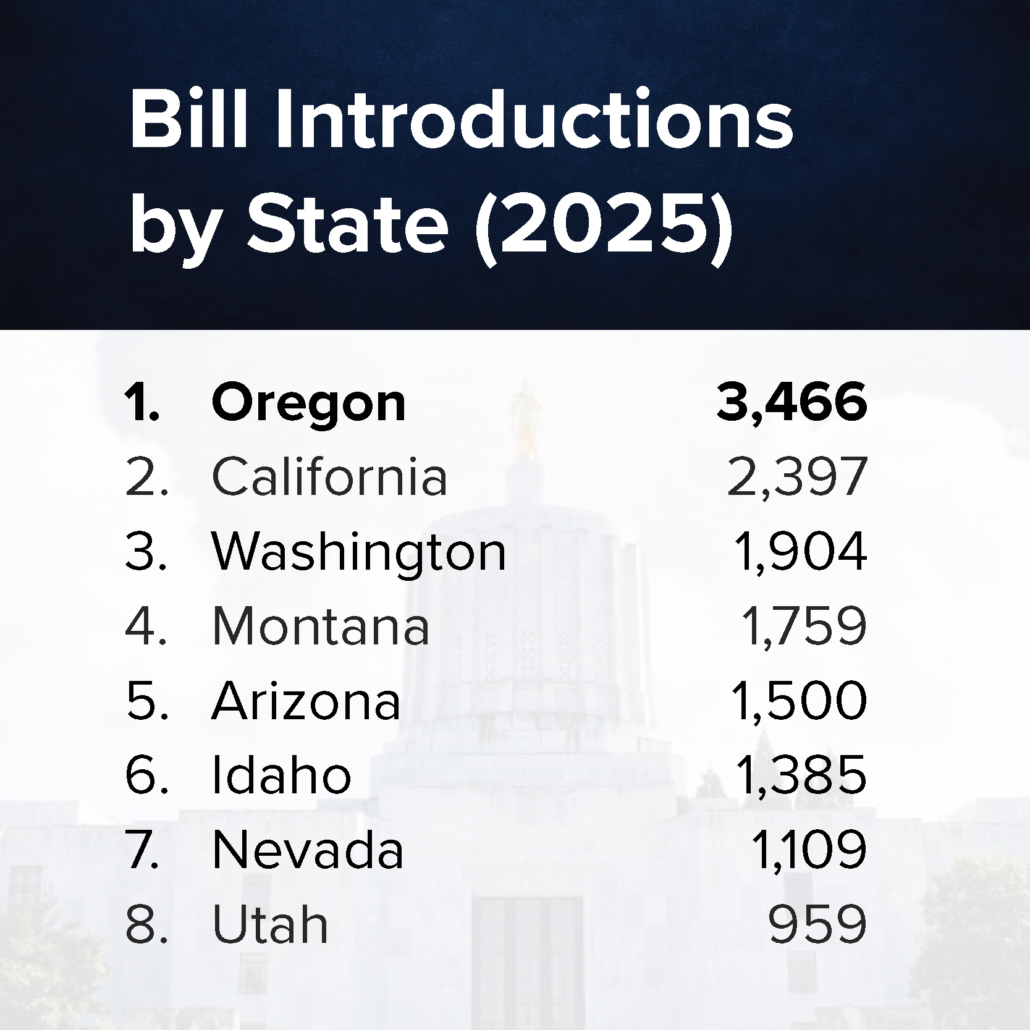
Hooray! Oregon, we are now #1. Has a nice ring to it, doesn’t it? Especially in contrast to so many metrics where our state has been kicked in the keister on comparative scorecards like educating children or business friendliness.
But, alas, when it comes to wanting to pass more laws, Oregon tops all states in the West.
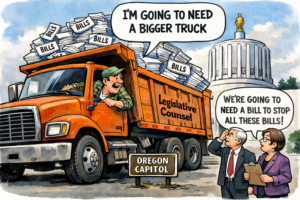
Yes, there is no limit to the imagination, but there is for legislative sessions. In 2025 legislators introduced a record number of bills, almost 3,500, overwhelming a process already strained by rushed hearings and limited debate.
It’s a short hop atop the alphabet from access to excess. Legislative leadership believes that time has come and have introduced HB 4002 to limit the number of bills legislators can request be drafted by Legislative Counsel. As in the game of golf, the more strokes you take is not a sign of productivity.
Most bills go nowhere and many of those aren’t even pushed by the legislators that requested them. The most prolific legislators say that it is there way of giving their constituents a voice, a place in the process. Others believe the sheer volume becomes a hairball in the P-trap of Legislative Counsel, slowing the flow of work on other legislators’ urgent requests. So many bills-so little time.
“We can lick gravity, but sometimes the paperwork is overwhelming.”
– Wernher Von Braun
Some legislators and legislative observers believe that quantity over quality diminishes the time to thoughtfully operate on the bills that do have a pulse. As session deadlines accelerate, committee chairs find themselves speed skating through agendas. Prolificacy does not always translate into productivity. One of the Legislature’s most respected member, Sen. Kate Lieber, authored only five bills in the last session
Oregon is indeed an outlier. Washington State has 57 more legislators than Oregon but they collectively introduced about half of Oregon’s tally in 2025 with 1,904 measures. California, with nine times the population of Oregon, has 30 more legislators but combined for only 2,397 bills.
Rather than speed skate, Alaska has opted for curling, a slower more tactical approach. They passed a whopping total of 33 bills during the entire 2025 session.
While some Oregon legislators have introduced hundreds of bills, it wasn’t always that way. Twenty years ago in the 2007 session, for example, Senate President Peter Courtney introduced 26 policy bills. House Speaker Jeff Merkley only introduced nine. Republican Senate Leader Ted Ferrioli introduced a grand total of five, while House Republican Leader Wayne Scott authored 17 policy bills.
Even the new proposal by the legislative leadership will still allow about 3,000 bills.
If ensuring constituents have access to the process is the objective, it doesn’t have to take a road trip through Legislative Counsel to accomplish. Here is a solution.
Legislation begins when a legislator fills out a legislative concept form identifying the issue and the proposed solution. Any legislator whose bill drafts hit the new limits can still draft additional legislative concepts, and then, at the bill deadline, deliver those documents electronically to the Senate President’s office or the Speaker of the House. Those offices could then have them referred to the respective Rules Committees where they can be posted on the committee website as ‘Filed Leg Concepts.’
Constituents can be directed there to see their idea has indeed been entered into the process. Additionally, a legislator could persuade the Rules chair to use one of the committee’s measure reserves to authorize the concept for drafting onto the next rung of the process if it garners sufficient interest by the committee.
Voice is heard. Process accessed. Logjam partially mitigated. It won’t solve all the problems of rushed testimony and deliberation. Skill level of Chairs will still be a decisive factor in committee efficiency and effectiveness.
But when it comes to a solution to cull the number of bills- well, there’s a bill for that.

