
Week Two: When the Calendar Tightened
If the first week of session was defined by the arrival of the math, the second was defined by the arrival of the calendar.
Deadlines that had felt distant at the start of session suddenly became operational. By Monday, the chamber-of-origin posting deadline required committees to publicly signal which bills they intended to move. Agendas expanded quickly. Work sessions multiplied. Measures that had lingered in negotiation were placed on calendars, not always because they were fully resolved, but because they needed procedural oxygen.
Week Two did not produce sweeping policy breakthroughs. It produced compression. And in a February session, compression is decisive.
The Posting Surge
Monday’s posting deadline functioned as a sorting mechanism.
To remain viable, bills had to be scheduled for a potential work session before the hard chamber-of-origin cutoff. That requirement alone was enough to inflate agendas across policy committees. Some of those measures were well-positioned. Others were placeholders — a way to preserve leverage or continue negotiations for a few more days.
Posting buys time, but it does not guarantee passage.
As Tuesday–Thursday committees approached their earlier work session deadlines, the field began to narrow. Bills either secured votes or quietly stalled. Monday–Wednesday committees followed close behind. What began as an expansive display of possibility became a disciplined process of attrition.
From Committee Output to Floor Convergence
The mechanical shift came next.
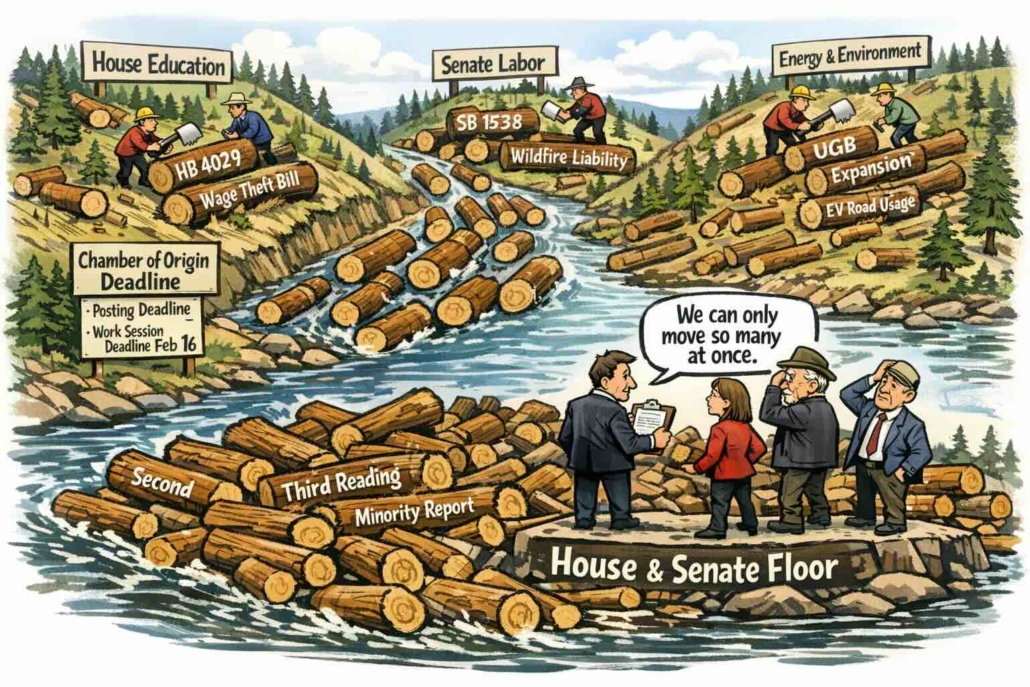
As committees pushed bills out in clusters, the output did not disperse evenly across the legislative calendar. It converged. First readings accumulated. Second readings swelled. Third readings began to cluster within days of one another.
With no Friday floor session to absorb late-week committee action, Monday’s calendars revealed the first visible log jam — a stack of measures awaiting floor consideration in both chambers.
This convergence is predictable. Committees operate in parallel. The floor does not.
Once measures reach second and third reading, they require full-chamber participation. Debate, amendments, minority reports, and recorded votes all take time. The institution shifts from distributed, technical work to centralized decision-making.
The pace appears to slow. In reality, the stakes rise.
The Quiet Winnowing
Behind the visible convergence was a quieter process. Not every bill posted early in the week received a vote.
The universe narrowed.
The inflated Monday agendas of Week Two masked the reality that many measures would not survive the week. Negotiations faltered. Amendments proved insufficient. Vote counts did not materialize. By the time the hard chamber-of-origin deadline arrived, committees could no longer advance their own chamber’s bills.
The “great winnowing” of session had begun — not through dramatic defeats, but through procedural finality. Nothing dramatic marked their disappearance. Committees simply lost the authority to act on them once the deadline passed.
This is the first large-scale contraction of the legislative field. It is neither ideological nor accidental. It is structural. Time, like revenue, is finite.
And once origin deadlines pass, attention shifts outward. House committees begin taking up Senate bills. Senate committees begin taking up House bills. The session pivots from internal refinement to cross-chamber negotiation.
Floor Time as the New Constraint
The second half of session will now be shaped less by committee ambition and more by floor capacity.
As more measures arrive on second and third reading calendars simultaneously, leadership must sequence debate strategically. Minority reports become more visible. Amendments become more targeted. Floor speeches lengthen. Recorded votes take on greater significance.
Policy committees naturally reduce activity when floor calendars swell. Members cannot be in two places at once. Staff bandwidth shifts toward preparing amendments and managing votes. The center of gravity moves to the chambers.
What looks like deceleration is, in fact, concentration.
Constraint, Reframed
Week One surfaced fiscal constraint. Week Two surfaced temporal constraint.
Both matter.
In a compressed session, there is limited opportunity to model second-order effects, reconcile competing amendments, or revisit complicated trade-offs once a bill reaches the floor. Decisions that once felt negotiable become binary. Move or do not move. Amend or accept. Advance or expire.
The narrowing is not a crisis. It is a phase change.
The question now is not how many ideas can be introduced. It is how many can be absorbed.
What Comes Next
As cross-chamber traffic increases, the coming weeks will be defined by convergence rather than expansion. Fewer new measures will appear. More floor votes will occur. Debate will become more public and more consequential.
The math established the limits. The calendar enforced them.
What remains is the institutional response — how lawmakers prioritize, how leadership sequences time, and how ambition adapts under pressure.
The session has entered its narrowing phase. And the floor will determine what survives.

