
Week One: When the Math Arrived in Salem
The first full week of Oregon’s legislative session made one thing clear early. This would not be a session defined by delay.
Within hours of bills becoming public, lawmakers began taking up some of the most contentious issues on the agenda. By midweek, fiscal constraints moved from background assumption to governing fact. And by Thursday, debates over health care, labor enforcement, and revenue policy exposed how little margin for error remains inside Oregon’s core systems.
This was not a week of sweeping decisions. It was a week of signals — about priorities, about limits, and about how the Legislature intends to operate under constraint. The math arrived, and it arrived loudly enough to shape everything that followed.
An Unambiguous Start
The tone of the session was set almost immediately.
On the first day, committees took up gun control legislation and measures clarifying the state’s posture on immigration enforcement, not after weeks of procedural warm-up, but within hours of bill introduction. The scheduling itself was the signal. In past sessions, leadership has been criticized for deferring controversial topics until later in the calendar. This time, there was no such delay.\
The decision to move directly into these debates did not occur in isolation. Alongside Judiciary, committees began early work on labor policy, paid leave administration, economic development coordination, and revenue enforcement. The combination mattered. It suggested a Legislature intent on addressing politically sensitive issues up front while simultaneously laying technical groundwork that will undoubtedly shape the rest of the session.
Rather than easing into the work, lawmakers moved quickly into it. Whether that pace would prove sustainable remained an open question.
Budget Pressure, Made Visible
That question sharpened on Tuesday.
The Ways and Means Committee convened an open public hearing focused on potential agency budget reductions. No specific cuts were proposed. No dollar targets were announced. Instead, lawmakers invited testimony on what would be lost if reductions became necessary.
The response was broad. Advocates and officials from education, health care, disability services, local government, labor, and family-serving organizations filled the record. The purpose of the hearing was not to choose among programs, but to surface consequences.
In doing so, lawmakers created a public inventory of material trade-offs before any line-item decisions were made. The hearing functioned as both warning and preparation — a way to establish expectations and document risks ahead of future budget action.
If Monday was about asserting priorities, Tuesday was about acknowledging limits.
When Hypotheticals Gave Way to Numbers
Midweek, budget discussions crossed a threshold.
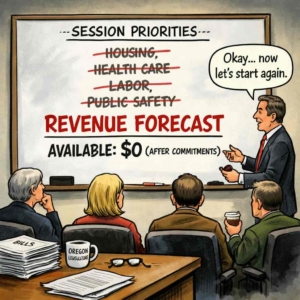
As scheduled, the state’s revenue forecast was presented — the document against which all budget recalibration this session will ultimately be measured. The forecast did not signal a fiscal collapse, but neither did it provide meaningful new breathing room. The numbers were flat enough to prevent panic and tight enough to force trade-offs.
That distinction mattered. Existing commitments continued to consume the bulk of available resources, leaving little flexibility for new initiatives without offsets or enforcement-based approaches. From that point forward, policy debates could no longer remain abstract.
Ways and Means subcommittees spent significant time examining agency capacity — information systems, benefits administration, cost allocation methodologies, and permitting infrastructure. These discussions were not about expanding programs, but about understanding how much of the state’s budget is already committed to keeping systems functional.
Labor policy reflected the same constraint. In the Senate Committee on Labor and Business, lawmakers considered a proposal to increase workers’ compensation temporary disability wage replacement from 66⅔ percent to 75 percent for lower-wage workers. During that discussion, Sen. Cedric Hayden raised concerns that higher replacement payments could push some recipients above income thresholds for other safety-net programs, potentially disqualifying them from benefits they currently receive.
Democratic members of the committee questioned whether that effect would occur, underscoring uncertainty rather than consensus. The exchange highlighted a recurring tension of the week: consequential policy changes increasingly carry cross-system implications, while the compressed timeline of a February session leaves limited opportunity to fully model second-order effects before decisions are made.
The math had arrived — and it was constraining the conversation.
Core Systems Under Strain
By Thursday, those constraints were visible across multiple policy areas.
In the House Committee on Health Care, lawmakers took up proposals affecting the Prioritized List of Health Services, the backbone of the Oregon Health Plan since 1989. Former Governor John Kitzhaber, who helped design the system, testified and engaged in a pointed exchange with Chair Rob Nosse (D-Portland) over whether current policy directions undermine the list’s original purpose and integrity.
The disagreement was more than symbolic. The Prioritized List is central to Medicaid coverage decisions, coordinated care organization contracting, and cost containment. The fact that its architect returned to publicly challenge legislative direction underscored how exposed the system has become under fiscal pressure.
Elsewhere, enforcement-oriented approaches advanced. The House Committee on Labor and Workforce Development considered legislation that would treat unpaid wages as theft of services, opening the door to criminal — and potentially felony — penalties for wage theft. Historically addressed through civil remedies and administrative enforcement, wage disputes would now carry the weight of the criminal justice system.
The shift fit the broader pattern of the week. New programs are expensive. Enforcement tools are not. In a constrained budget environment, accountability mechanisms become an increasingly attractive policy lever.
Revenue debates followed a similar logic. The House Committee on Revenue revisited the long-running dispute over the state transient lodging tax, signaling a willingness to reexamine established revenue sources early in the session. Lawmakers also reopened the question of whether Oregon should remain connected to recent changes in the federal tax code — a technical decision with broad implications for businesses, pass-through entities, and long-term tax planning.
Even energy policy reflected the same pragmatism. Proposals to streamline siting and permitting for certain renewable energy projects were framed less as ideological shifts than in past sessions, and more as responses to federal tax credit timelines and development risk. Whether these changes arrive in time to address concerns raised by renewable energy developers during last year’s special session remains an open question, particularly given Oregon’s historically slow permitting process.
Across committees, sustainability — not expansion — emerged as the dominant concern.
Constraint as the Defining Condition
By the end of the week, the Legislature had not resolved its biggest questions. But it had clarified the conditions under which those questions will be answered.
This is not shaping up to be a session defined by sweeping new commitments. It is one defined by constraint — fiscal, administrative, and temporal. Controversial issues were taken up early, not deferred. Budget pressure was surfaced publicly, not minimized. And once the numbers arrived, even well-intentioned proposals exposed how tightly Oregon’s systems are now coupled.
The posture is not crisis management. It is triage.
For lawmakers, that means choosing where enforcement substitutes for spending, where legacy systems can be adjusted before breaking, and where ambition must yield to feasibility. For observers, it means watching less for grand announcements and more for how quietly — and consequentially — trade-offs are made.
The math has arrived. The session will be shaped by how lawmakers respond to it.

