Vanessa Nordyke and the Challenger’s Test
This is the third of a three-part series on the 2026 Salem mayoral race. It analyzes City Councilor Vanessa Nordyke’s potential path to victory. The first article looked at the Salem Chamber of Commerce Candidate Forum, sponsored by The Political Center. The second article examined Mayor Julie Hoy’s incumbency campaign.
—
Just one year after taking office, Salem Mayor Julie Hoy is already facing another election. This time her key opposition is also a sitting member of the city’s governing body: Councilor Vanessa Nordyke. It sets up an interesting political dynamic of both past setbacks as well as shared ownership of recent successes.
Challengers often benefit from the outsider advantage of being able to criticize an incumbent’s failures without having to defend their own actions. It is often referred to as the ‘Throw the Bums Out’ strategy, where the challenger owns the ball and plays only offense while the incumbent is having to constantly defend their own goal line. The playbook consists of assigning blame, promising disruption, and positioning themselves as outsiders to decisions voters may be dissatisfied without having to explain how they would have governed differently at the time those decisions were made.
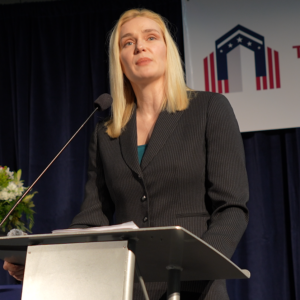
Councilor Vanessa Nordyke does not get that luxury in this election.
Elected to the Salem City Council years before Mayor Julie Hoy took office, Nordyke is part of the governing body that presided over both the city’s fiscal crisis and its subsequent stabilization during the past year. That reality forecloses the outsider posture and presents a more delicate strategic course — arguing for a change in leadership when the city’s trajectory appears to be improving since the incumbent mayor took office. Pushing that envelope too far would also discount the ability to share credit for those improvements as a member of the city council.
This constraint defines the central challenge Nordyke must overcome: how to persuade voters that new leadership is needed without repudiating outcomes she herself helped deliver.
Claiming Credit Without Owning the Office
In the first debate, Nordyke made a strategic choice to emphasize alignment rather than opposition on core policy questions with the incumbent mayor. She highlighted shared opposition to new payroll taxes, support for an 18-month moratorium on new business fees, skepticism of the proposed Cherriots wage tax, and her role in stabilizing the city’s finances.
The approach is calculated. By aligning herself with broadly popular outcomes, Nordyke positions herself to share in the credit for the city’s improved fiscal footing rather than ceding it entirely to the incumbent. It also helps define the terms of engagement, hoping to dissuade conversations about policy decisions in her previous five years on the council.
It is a difficult balancing act between alignment and disassociation. Nordyke must therefore answer a harder question: If the current trajectory is largely right, what specifically warrants a change at the top?
Reframing the Debate: Process Over Progress
Rather than asking voters to dismiss the results of the past year, she has encouraged them to scrutinize the process rather than outcomes.
Nordyke has regularly referenced a recent Oregon Government Ethics Commission finding involving Mayor Hoy vote on a land use decision that was requested of the council by a developer who was also a contributor to Hoy’s campaign. Hoy did not receive any personal financial gain by supporting the proposal, but the optics raised complaints that she should have recused herself from the vote. Nordyke’s argument may be harder to land given her own support for the measure which passed the full council with a strong vote.
The strategy is further complicated for Nordyke to make given her own previous letter of education from the Oregon Government Ethics Commission. These letters are a gentle critique rather than hefty fines and are common for many in Oregon who serve in uncompensated positions such as city councilors or school board members, suggesting an awareness of the arguably confusing ethics laws that catch many unseasoned politicos off guard.
In strategic terms, Nordyke is asking voters to prioritize process over progress. A defensible argument, but perhaps low impact for high risk of potential backlash from voters’ response to making it.
A Broader Vision of City Leadership
Where Nordyke’s candidacy diverges most clearly from Hoy’s is not on fiscal policy, but on the scope of what she believes city leadership should encompass.
Nordyke has articulated a vision of the mayor’s office as a more visible ambassador for the values of the city, particularly when national policy decisions directly affect Salem residents. She has supported local actions intended to respond to the impacts of federal immigration enforcement, framing those efforts as a necessary expression of the city’s values rather than a departure from municipal responsibility.
Housing as Opportunity—and Constraint
Housing represents both an opening and a limitation for Nordyke’s campaign.
She can credibly point to a record of supporting housing development and increased supply—an issue of central importance to Salem voters. Yet many of those initiatives unfolded under a mayoral administration that shared those priorities and championed fulfillment of those goals.
That dynamic complicates any effort to claim singular ownership. Nordyke’s challenge is not to demonstrate commitment to housing policy, but to explain how her leadership would produce materially different results from those already in motion.
In practice, this requires persuading voters that leadership style, public engagement, and the symbolic use of the mayor’s office — not policy direction alone — are where change is most needed.
The Risk–Reward Equation
Nordyke’s path to victory relies on executing a dual strategy: preventing the incumbent from monopolizing credit for improved conditions while offering a compelling alternative vision of what the mayor’s office should represent. It carries both risks and rewards.
The strategy may not only determine the outcome of the race, but how Salem voters ultimately define the role of their mayor into the future.




 Voter Perception on the “State of the City”