Economic Prosperity Flying Under the Radar
Earlier this year, Gov. Tina Kotek announced a new statewide Prosperity Council with its stated objective to “recommend actionable steps to accelerate Oregon’s economy, create good paying jobs, and recruit and grow Oregon’s businesses.”
Ideas will be itemized, details deliberated, findings found, papers produced. The results? Still to be determined.
How’s this for fitting the assignment:
- 23,000 jobs (over 12,000 of them new, permanent jobs) …
- Increasing local purchases five-fold …
- Doubling personal income …
- More than doubling regional economic impact from $1.6 billion to $3.6 billion …
- All while pocketing $56 million per year in new tax revenue.
Oh, and it could be initiated in a matter of months, not decades. Can the state of Oregon afford that kind of prosperity?
“Sometimes the best things are right in front of you;
it just takes some time to see them.”
— Gladys Knight
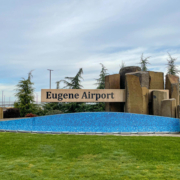
Yes, sometimes, while you’re climbing that orchard ladder, the best fruit on the tree is hanging on the limb right below your feet. Eugene’s airport is hanging in plain sight.
Ballooning travel demand has found the airport at full capacity since 2021. Airlines are eager to add the Mid-Valley airport to some of their long-haul destinations, and businesses and institutions like the University of Oregon are clamoring for easier travel access. UO’s move to the Big Ten Conference has swelled demand from out-of-state visitors, but the region struggles to accommodate them.
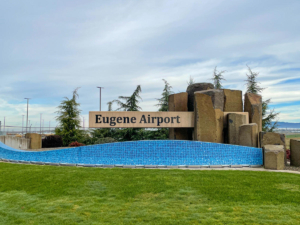
The numbers cited above are from a study conducted by the airport and the City of Eugene, which owns the facility. A plan for a new concourse has been drawn and vetted, but money for the expansion remains elusive. The airport gets $1 million here, six months later another $2.1 million there. It is a long slog to cobble together the estimated price tag of $240 million when inflation will escalate the cost of construction far faster than the cobbling will take.
While $240 million is not chump change, from a major projects standpoint it is dwarfed by other, less reliable economic and transportation aspirations. The I-5 project at the Rose Quarter has grown six-fold from $450 million to an estimated $2.5 billion today with no money in sight. The interstate bridge project is now estimated to cost 60 times more than the Eugene airport expansion at $14.6 billion. Even the modest renovation of the Moda Center is estimated at more than twice the price tag of the new airport concourse.
The Moda Center regional economic impact stands currently at about $670 million while sustaining 4,500 jobs, only a quarter of the airport’s impact after expansion, and one-sixth of the regional economic impact. And the state gets to keep the tax revenue.
Let’s say the Eugene project has gone up another 10% (they all seem to do) since the study and sits somewhere around $265. If the state tendered an immediate $100 million into the project — contingent on the airport leveraging the other $165 million in private borrowing and local officials expediting permitting — shovels could begin relatively soon thereafter.
Here is another twist. Most grant money from the state is never seen again. In this scenario, the new concourse will generate not only enough new tax revenue in very short order to replenish the state treasury, but the state will also make a profit every year thereafter. It’s the gift that keeps on giving.
The airport is currently planning a major renovation of its existing facility at a cost of more than $200 million where the money has been mostly identified. The problem is that improvements like adding new seating doesn’t generate new revenue. Substantial new revenue will come only by the doubling of capacity, which is embedded in the other plan for the new concourse.
The airport should consider the strategic advantage of combining the renovation with the expansion as one project, much as was done at Portland International Airport. A single contract could provide both cost and time efficiencies while building enthusiasm for the project. Construction projects will never be cheaper than they are today.
Private capital will then be repaid through airport bonds backed by the increased airport fees collected from the airlines and passengers who will benefit from the added routes. Airline user fees are the prime source for airport operational capital across the country.
In this scenario, taxpayers don’t pay. Airlines and other airport users foot the bill. The $2.1 billion redo of PDX is being paid for by the airlines and associated users with revenue generated by the new capacity.
The dilemma facing the Eugene airport is that they won’t generate new fees until the expansion is completed. It is like that chicken and egg. You have to have the expansion to get the money, but they don’t have the money to do the expansion.
Major airlines have already informed airport officials they could open routes from Eugene to Honolulu, Boston, Orlando, Atlanta, Austin, Minneapolis, and more. As an environmental bonus, estimates are that travelers starting their flights from Eugene will save the climate the release of over $5 million tons of carbon dioxide a day.
Unlike many multi-million dollar proposals offered to the Legislature over the years, this isn’t a pie-in-the-sky, trust my enthusiasm kind of opportunity. It is real, tangible and verifiable.
The City of Eugene, Lane County, the University, the local chamber and citizens have all voiced support for the new concourse. But to date all parties seem to be looking at the other one to make it happen. Notably, no one has ever introduced a bill in the legislature asking for partnership or even asked the Governor for help.
The airport director, Cathryn Stephens has been a champion of the expansion and spreading the word to anyone who will listen. Maybe the Governor’s Prosperity Council will provide the ears this project deserves.