

What Organizational Days Revealed, and What They Didn’t
Short session begins Feb. 2 with fiscal questions top of mind
Legislative Organizational Days are often misunderstood. They’re not about passing bills or settling debates. They’re about something quieter, and often more revealing — deciding what deserves attention first.
Over three days at the Capitol in mid-January, 42 of the Legislature’s 55 committees and subcommittees met to preview legislative concepts, receive agency briefings, and frame the issues lawmakers hope will advance during the 35-day February session, which begins Feb. 2. These meetings are less about neutral updates than they are about signaling which topics committee leaders choose to elevate and begin building momentum around.
Just as important are the issues they choose not to surface. Those omissions send a different signal, but an equally meaningful one.
Taken together, Organizational Days offered a revealing snapshot of how legislative leadership is preparing to govern in a moment defined by fiscal uncertainty, federal cost shifting, and administrative complexity. Several patterns stood out.

Managing Complexity, Not Constraint
Across committees, a consistent posture emerged: downward budget pressure is real but is being treated as something to be managed rather than used to constrain existing programs or commitments.
While program costs are increasing and the details of federal cost shifts to the state are complex, those pressures are being approached as administrative challenges to be absorbed through additional oversight, staffing, and management, rather than as a trigger to reconsider or narrow program commitments.
This posture appeared most clearly in discussions involving large, ongoing state systems, where rising costs and federal uncertainty were framed as problems of implementation and compliance, rather than structure. The emphasis was on administering increasingly complex systems, not simplifying them, even as the funding environment becomes less predictable.
Revenue Signals: Decisions Made and Deferred
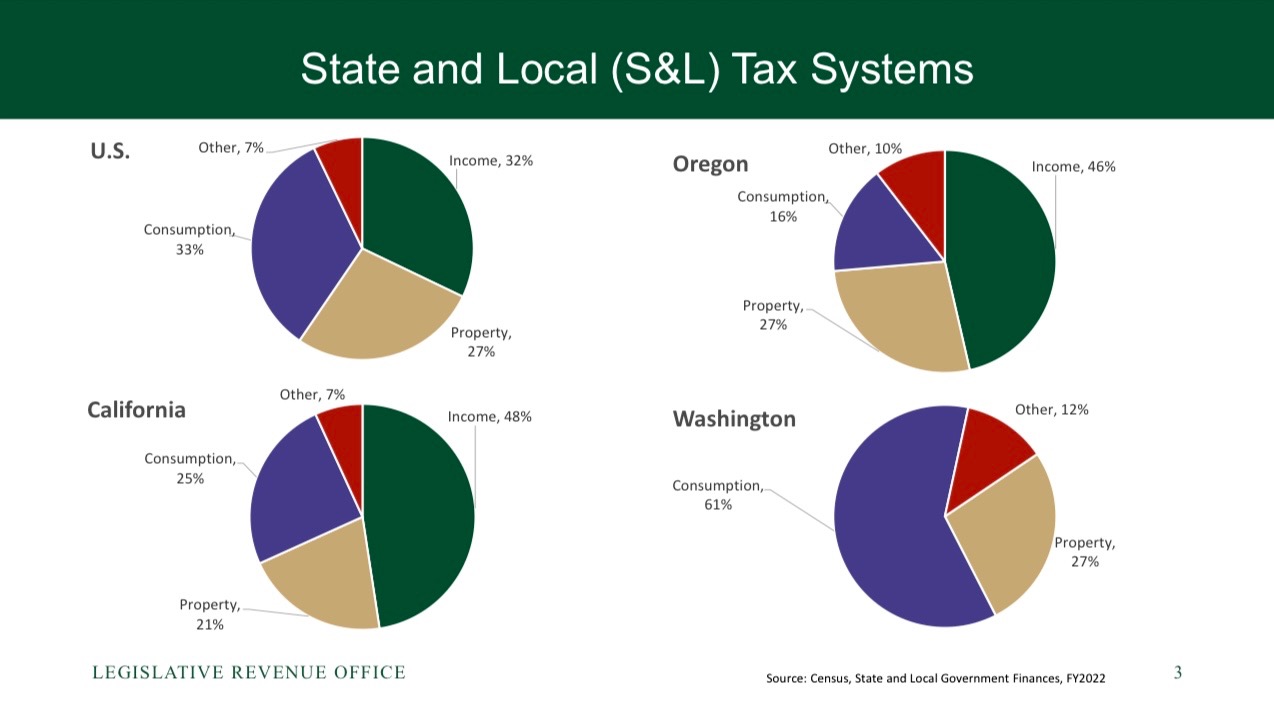
If there is one area where committee activity sent unmistakable signals, it was revenue — not because lawmakers resolved Oregon’s structural funding challenges, but because of how they chose to approach them.
On one end of the spectrum, lawmakers appear willing to make politically difficult, highly specific choices when it comes to Oregon’s connection to the federal tax code. Bills advancing in the revenue committees would selectively disconnect Oregon from portions of federal tax law changes, preventing certain federal tax cuts from flowing automatically through the state code.
These are affirmative political decisions and will determine which provisions remain aligned, which do not, and which industries or activities are affected. Lawmakers appear prepared to own them directly.
Alongside that sits a far more consequential and precarious proposal: the introduction of a retail sales tax framework. The bill does not specify a tax rate, define the scope of taxable goods and services, or resolve core questions about exemptions or distribution. Instead, those defining decisions would be delegated to unelected bureaucrats after passage.
That structural choice matters. It allows the Legislature to advance a fundamentally transformative revenue policy while deferring the most politically sensitive decisions until later. This approach reduces political accountability at a time when accountability matters most. Whether the ultimate objective is long-term tax stability or the pursuit of new revenue, this is left unresolved in statute and leaves agencies to determine outcomes through rulemaking rather than open legislative debate.

Lessons From Tolling Backlash
Oregonians have seen this governing model before. In 2017, the Legislature authorized tolling through HB 2017, delegating core decisions like where tolls would be placed, how rates would be set, when pricing would vary, and who would be exempt to the Oregon Transportation Commission and ODOT. What followed were years of internal planning, environmental review, and administrative rulemaking, largely outside public view.
When the details finally surfaced, they did not arrive gradually. They landed with an incredible shockwave, and the sweeping proposal stunned voters who did not even realize such a program was being actively developed. The plans included nearly three dozen tolling points across the Portland metro area along with variable, time-of-day pricing that charged commuters more during peak hours, regardless of whether they had any realistic alternative.
The backlash was swift and overwhelming. A revenue structure of enormous consequence appeared fully formed, without having passed through a visible, accountable legislative discussion. Only then did the outrage reach elected officials in force, culminating first in a gubernatorial pause and ultimately in Gov. Tina Kotek’s decision to abandon the tolling effort entirely.
The parallel is difficult to ignore. Delegating taxing authority may simplify legislative politics in the short-term, but it risks recreating the same cycle of delayed transparency, public backlash, and eventual policy reversal.
Transportation by Omission: The Conversation They Didn’t Have
Since the Legislature last met, the transportation landscape has shifted dramatically. The transportation package passed in the emergency session has formally qualified for a ballot referendum. Gov. Kotek has publicly called for its repeal in advance of that vote, while Republican lawmakers — including those who supported referring the package to the ballot — are now crying foul, arguing the Legislature should not repeal a law voters are poised to consider.
At the same time, reporting has revealed that the estimated cost of the I-5 bridge project has nearly doubled, further intensifying scrutiny around transportation funding and governance.
Against that backdrop, one would reasonably expect transportation committees to spend significant time grappling with those issues: sorting through the ballot referral, the governor’s repeal call, the escalating cost of the I-5 bridge, and the political fallout surrounding all three. Instead, committee discussions focused on comparatively mundane topics such as passenger rail service and long-range planning concepts, while neither of the two 800-pound gorillas in the room was addressed.
In a moment when transportation may be among the most volatile policy arenas in Oregon politics, the decision to sidestep those debates was itself a signal. Not one of resolution or momentum, but of caution, deferral, and unresolved conflict. And the hardest questions are still waiting offstage.
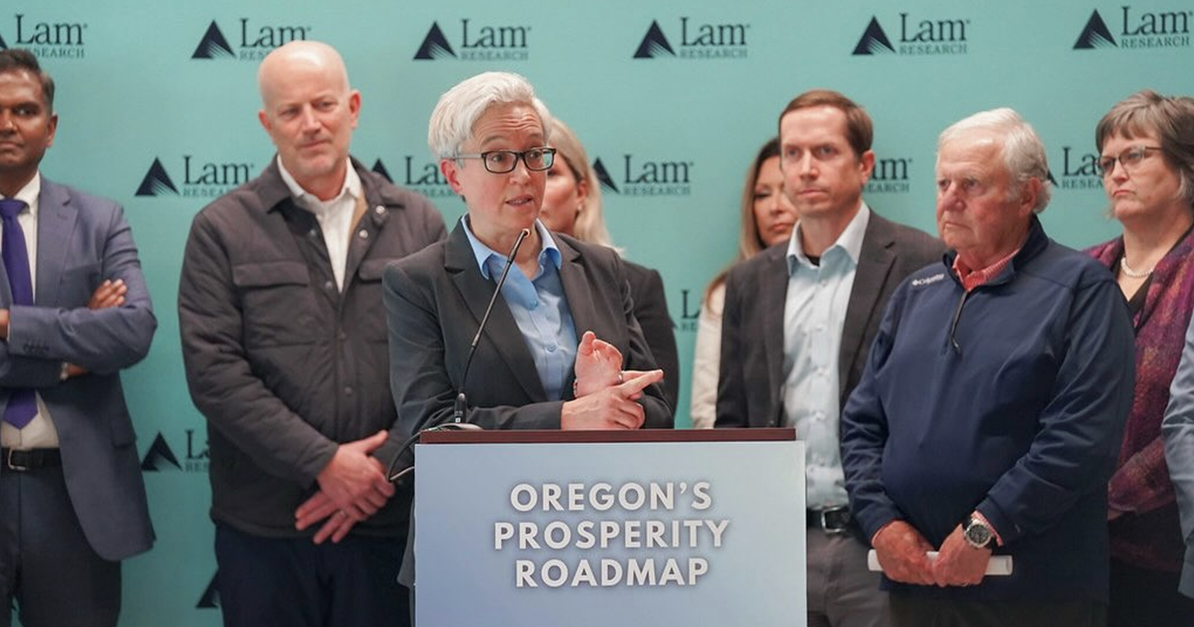
Image from Gov. Tina Kotek’s Facebook page.
Did the Governor’s Prosperity Roadmap Show Up?
One of the most closely watched questions heading into Organizational Days was whether Governor Kotek’s newly announced Prosperity Roadmap would meaningfully surface or remain largely rhetorical.
It did show up, but in a measured, early-stage form.
Committees received an informational briefing outlining the Roadmap’s diagnosis: slowing population growth, elevated unemployment, and business outmigration. The proposed response centers on retaining and growing businesses, accelerating job creation, and modernizing economic development tools.
The legislative concepts introduced were tangible but targeted: fast-track permitting for large projects, permit audits to streamline timelines, investments in industrial site readiness, and updates to enterprise zones aimed particularly at rural and smaller communities.
What is notable is not what’s included, but what isn’t. There is no sweeping funding package, no immediate structural overhaul, and no near-term reset of Oregon’s cost structure. Instead, the Roadmap appears positioned as scaffolding: organizing government, identifying barriers, and laying groundwork rather than delivering immediate transformation.
For supporters, this reflects pragmatism. For skeptics and those within the business community, it reinforces the central question: how real, how durable, and how operational this initiative will ultimately become.
The Signal Beneath the Surface
Legislative leaders are signaling a willingness to manage complexity rather than unwind it, to study and position rather than fully resolve, and in some cases, to delegate decisions that carry significant political consequence.
Whether that strategy produces stability or volatility will depend not on intent, but on execution and on how long accountability can remain deferred before the public demands it back.

