

Oregon Government’s Secret Society
They meet in secret. No public agenda, no disclosed attendance records, no recorded votes, no public hearing on cases and no final action taken in public view.
Neither the Legislature nor the public have a clue what goes on behind the closed doors of the Oregon Commission on Judicial Fitness and Disability (CJFD). Fingerprints on the doorknob are wiped clean. In the last 10 years, more than 2,000 complaints have been filed with the Commission charging some form of judicial misconduct, though not a single public hearing has taken place on any of them.
The last time a public hearing was held on a case came in 2015 when it conducted a well-publicized hearing in the case of Judge Vance Day after he refused to perform marriages of same sex couples, among other complaints. And that came only after a public uproar and wide media coverage of the incident. That’s when the Commission awakened from its public slumber, turned on the lights, and declared it had judicial oversight firmly under control.

In fact, such cases appear to be the only times the Commission provides transparency, if grudgingly, to its proceedings. The Oregonian reported on this phenomena back in 2015.
The article noted that despite thousands of complaint filings, only 21 judges have been disciplined in the 50 years prior to 2015. Those that did reach a public hearing were almost always those who had already reached public scrutiny. A DUII arrest in 2002. A recall campaign against a judge for alleged misconduct in Wallowa and Union counties in 1994. A judge in Multnomah County exposed as being married to two women at the same time, and another in Hood River for sexual harassment, intoxication and drinking on the job.
If it is in the press, the Commission jumps right on it.
In the years since the Day case, only two other judges have been referred by the Commission and received sanction by the Supreme Court. The Commission did not hold a public hearing in either case.
Recently two more judges have come into the public spotlight. One for their role in throwing out a large damage judgement against PacifiCorp and later reported to have previously worked at the firmthat had the utility company as a client. The other involves a judge in Marion County who has been accused publicly of making vulgar comments about other members of the judicial system at a judges’ association conference.
The public scrutiny given these accusations will put the focus on the Commission. But few incidents make it into the press.
The question is, how are the press or the public at large to know whether the Commission is always giving complaints the scrutiny they deserve if there are no agendas, no minutes, and no publicly revealed dispositions or hearings?
The Commission asserts that it is exempt from Oregon’s Public Meetings Law, not just in judicial proceedings, but in its entire governance structure as well.
That bold assertion is being challenged now before the Oregon Government Ethics Commission. The Oregon Chapter of the National Parents Organization filed a complaint with the Oregon Judicial and Disability Commission last month stating the Commission was violating Oregon’s Public Meeting Law. The Commission responded, denying the grievance asserting it was exempt from the law. That denial is the trigger that ripens a complaint to the Oregon Government Ethics Commission which was filed on June 15.
The complaint asserts, in part:
“The structural consequence of the Commission’s theory deserves emphasis. Under ORS 192.660(4), representatives of the news media must be permitted to attend executive sessions, subject only to narrow statutory exceptions-a requirement this Commission (OGEC) has enforced and the Attorney General has repeatedly affirmed. By declaring that its (CJFD) case-review meetings are not ‘meetings’ at all, the CJFD does not merely close its deliberations to the general public, it eliminates the one mechanism by which the institutional press could observe even the lawful confidential portion of its work, and it leaves legislators-who fund the Commission and who were told its work advances judicial accountability-with no means of observing any Commission action whatsoever. No notice, no agenda, no minutes, no votes; not for the public, not for the press, not for the Legislature or the OGEC.”
The Oregon Judicial and Disability Commission appears to be the only public body claiming a right to be cloaked in total secrecy. That’s not the case for the Oregon Medical Board, the Teacher Standards and Practices Commission or another oversight board. Physician licenses, patient complaints and teacher careers are no less sensitive to the parties involved than judges.
Now it is up to the Oregon Government Ethics Commission to decide whether all governance of the CJFD is off limits to public and legislative scrutiny. Legislators, the press, and the public have a vested interest in the outcome.
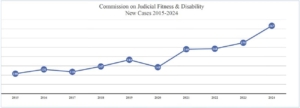
CJFD does operate on a very thin budget. Perhaps too thin. Complaints to the Commission have doubled in the last five years. Yet the Legislatively approved budget is only a little over $300,000 a year.
The Legislature may want to consider additional resources to the Commission along with a directive for greater public visibility. Sunshine is the best disinfectant for public governance.

